Sunday, 14 October 2012

Machu Picchu - Sacred Geography

Someone asked me why I have to go all the way to Peru to look at ruins.  My response - you have to be there to see that these are not just any ruins, you have to see the remarkable stone work in the buildings, framed against the backdrop of the layers of majestic mountains around the site and its amazing location on a saddle between two peaks, with steep drops on both sides of the ledge.  The latest interpretation is that Machu Picchu was a sacred site for the Incas because of its "sacred geography" (Machu Picchu, Exploring an ancient sacred center by Johan Reinhard and Turn right at Machu Picchu by Mark Adams) - built on and around mountains and close to the sun - all of which were very significant for the Incas.  There were temples at all the high points on the site and sacred mountains at all the cardinal points.  Indeed, if you visit, make an effort to find some quiet time to steep in the majesty of the surrounding mountains; the spirituality of the site is palpable.  It was not easy to find it in the midst of the hordes that came through the gates, therefore it is important to strategize the itinerary, which our guide did.

The typical day trip to Machu Picchu had tourists leave from Cusco in the morning, spend 3.5 hours travelling on a bus, then a train then another bus before arriving middday at Machu Picchu; spend a few hours on the site then leave.   Our tour arrived mid-afternoon, just as other tourists were about to leave and the place gradually calmed down.  We spent some time on some of the important sites with our very knowledgeable guide and took our time because we knew we would return the following day.  Time and space was needed to get the most out of this unique place.  And I was glad I made an effort to find a tour that afforded two days at Machu Picchu.  You can see from the photos below how the mountains were everywhere and how the buildings echoed the mountains around them.

The main gate - you walked through and the entire Machu Picchu site opened up in front of you

View from the Principal Square - surrounded by "skyscraper" mountains


The "Royal Mausoleum" - one of the first pieces we saw.  The steps carved out of  a single piece of granite that grew from the earth below; behind it, the Incan three steps - heaven, earth and the underworld and beyond that, in the cave, first class stonework for buried royalty.  Above this cave, sat the the Torreon, the Temple of the Sun (photo below), so called because in the winter solstice in June, the sun would come through the east facing window and cast a rectangle of light onto the huge carved rock in front of it.  The only round building on the site, it was also aligned with the two mountains, one on each end - Huayna Picchu and Machu Picchu, hence the suggestion that it was for mountain worship. 


A closer look at some of the first class stone work in some of the buildings - mortar less, perfectly cut and stacked


This is one of 16 fountains found on the site, part of a complex system of water supply on the site


The ever-present sacred mountains - which ever way we turned

The perfect symmetry of the portals


Steep drops (some terraced) on the sides all the way down to the Urubamba River, which curiously wrapped right around  the promontory that  Machu Picchu sat on - you can see the river coming around on the other side of Machu Picchu (photo below - lower right corner)


The main temple with its wall niches, foundation collapsed on one side, which was how the explorer Hiram Bingham found it in 1911.

Beside the main temple, is the Temple of the Three Windows, a significant Inca symbol.  The windows framed the mountains in front.  This area has been called the Sacred Plaza because of the temples and the Intihuatana (ritual rock) further up near the top of this site.  The rocks in these buildings are particularly large (some as much as three tons - see photo below) and the workmanship first class, denoting this as the most important area on the site.


Look at the precise fit of the rocks


This piece of rock in the sacred plaza must have been a compass - pointing exactly due north


78 steps took us up to this Intihuatana, a ritual stone that must have been also a sun dial.   It was said to give off energy and many visitors considered it a source of magnetic power.


The Sacred Ceremonial Stone - almost a perfect echo of the mountain behind it

The four Ecuadorian boys gave a sense of the size of the rock.  Guido, the boy in the orange poncho, had asked to have his picture taken with me earlier - what an honour!


Awe-inspiring!


Wednesday, 10 October 2012

The long road to Machu Picchu - Ollantaytambo, Aguas Calientes

From Urubamba, we drove to Ollantaytambo to take the train to Machu Picchu.  There was time before the train for a short tour of the old Inca town with many original Inca streets and walls.  It has some of the oldest continuously occupied dwellings in South America.  High above the town were remnants of what were described as silos for storage from Inca times.  Temple Hill was an impressive fortress-like structure in town although it was really a temple.  We would be visiting this on our way back from Machu Picchu.  More on this later.


Silos above the town's Inca streets.


Original Inca doorways and courtyards

Not an Inca door but a nice one with the Inca cross
We visited with a local family in this original Inca house and courtyard.  It's a one room home where the family slept, cooked, ate and raised guinea pigs (cuy - a delicacy here) to supplement the household income.  


Guinea pigs raised as a delicacy
The family altar - you can see the ancestors' skulls near the top of the photo


Dried goods


Ancient walkways

Temple hill


The train to Machu Picchu
with the Vista Dome


The train ran along the Urubamba River cutting through the fertile Sacred Valley.  If you are taking it, try to get a seat on the left side of the train as that is the river side.  Lots to see beside the river.


The 4 day Inca trail started at this bridge just a short distance out of Ollantaytambo


The town of Agua Calientes where the train dropped us off and we took a bus up to Machu Picchu.  It was a 25 minute ride on a rough mud road with hairpin bends.  I was surprised I did not get car sick.


Finally, the entrance to Machu Picchu -

and here is the much awaited view...


Sunday, 7 October 2012

The long road to Machu Picchu - Chincheros, Urubamba

I'd like you to believe that the long road was the Inca Trail but had we even attempted it, we would never have made it as the highest part of the trail was over 13,800 ft and we could barely exert ourselves at 9,000!  The long road we took was the International Expeditions' tour itinerary before Machu Picchu the purpose of which was to acclimatize us to the high altitude.  I was considering how best to blog about our very intense 10 day trip to Peru and thought it best to say it the way it was - how we experienced it starting from the time we landed in Cusco (elevation 11,200 ft).  

We were whisked off in a bus that took us through the outskirts of Cusco and a steep climb further up the mountain to the town of Chincheros at over 12,300 ft.  We were supposed to spend a restful afternoon observing the intricacies of Andean weaving.  But it was hard to stay cool when we were thrown into so much culture shock, even though it was all very enjoyable.

You can see from the photos below the demonstration by four generations of the Minka family of the weaving process starting with the spinning and dyeing of the wool using natural colourants.  It was eye-opening to say the least.  We then drove to Urubamba in the Sacred Valley, at 9,400 ft, an accepted location for acclimatization.  We spent the night at the splendid Aranwa Sacred Valley Hotel - an experience in itself (more about this later).  In between, we had a Peruvian buffet lunch and a delicious dinner where I had my first taste of alpaca.  Look out for future posts on Peruvian food on Foodsparks.


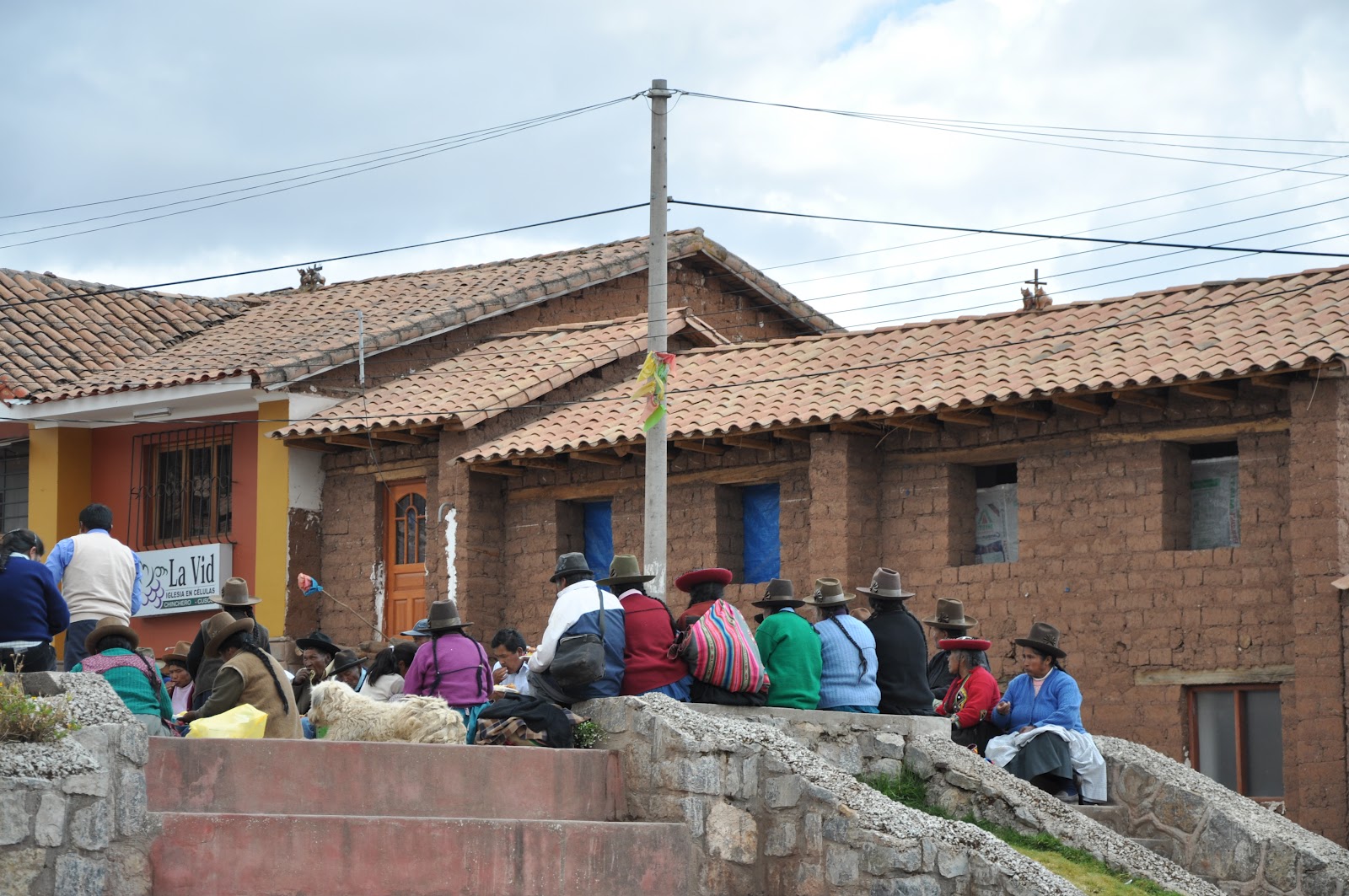
Streets of Chincheros


Common roof decorations - two bulls (mother earth, happiness, health, fertility) beside two bottles (fertility) and in front of a crucifix - they've got it all covered!  This is our first exposure to the duality pervading Peruvian religious life.
Learning all about organic textiles with the Minka family  - notice the unique stove and chimney and the guinea pigs underneath


The root was grated to produce the cleaner for the wool


Cleaning the wool


Cleaned!

The different plants used as colourants


Guess what colour this cactus produces?


Answer on the palm


The spinning Minkas...


Serious weaving - it's all in her head!  


The finished product


Market day in Chincheros


Photocopies?  Why?  What an unlikely spot!

The spectacular view of the Sacred Valley


The Urubamba range in the distance - always in view


And in the most unlikely of places - the Aranwa hotel with splendorous grounds and chapel...

Machu Picchu coming up!