Showing posts with label cloisters. Show all posts

Saturday, 6 August 2011

Silvacane Abbey

No matter how similar in style and structure the various abbeys and churches from the middle ages, they all have a different ambiance.  Silvacane Abbey, near La Rocque-d'Antheron, is no longer a religious establishment, but it retains a sombre and peaceful atmosphere.  In fact, I found it more restful than the Abbe Senanque because it was not swamped by tourists and there were no guides.  I was able to take it at my own pace and just soaked in the simplicity and harmony that was inherent in the architecture of the Cistercians.   You can see for yourself below.


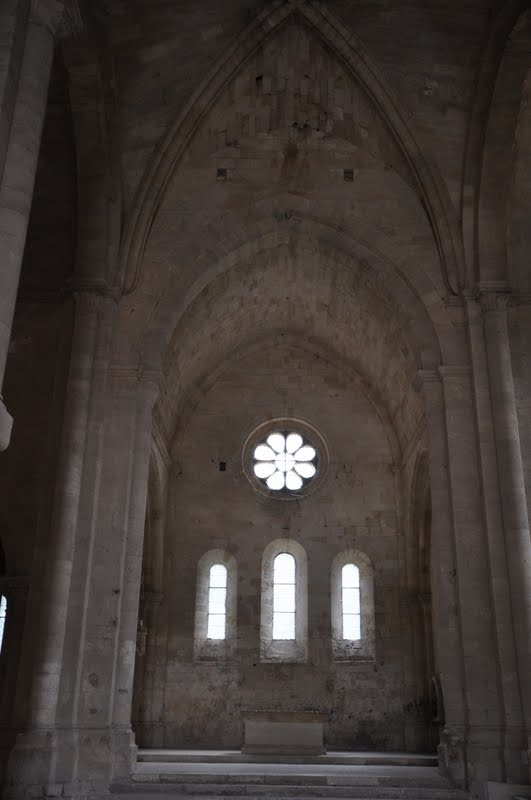
The chapel was almost devoid of decoration, which made its architectural lines all the more striking.

An appropriately placed work of art added to the ambiance.


This is the entrance to the dormitory.


A dormitory very similar to the one at Senanque but more interesting because of the many windows.


The cloisters are stunning in their simplicity.


This is a window decorated with fingerprints!  A touch of contemporary art.


This would be a great place to do some Zen meditation.

Monday, 1 August 2011

Abbey in the Valley

By now, you would have figured out that most of our destinations in Provence seemed to include a religious institution of some kind or other.  No, we were not on a pilgrimage but the church was so dominant in the middle ages that religious structures seemed to be the only ones around or still standing and worth seeing.  The Abbe de Senanque (apologies for all the missing accents in my French names -  I have yet to find them on the blogging site!) is hidden in a valley near the town of Gordes.  We had to drive down a narrow winding mountain road to get here, all the time keeping our fingers crossed that we wouldn't encounter a tour bus going in the opposite direction. The location is very secluded and I could imagine it would be very peaceful when all the cars were gone. It is an active monastery and guided tours in French were again the only way to see it.  


This used to be the dormitory for the monks.


Here is the chapel.


Note the asymmetry in the location of the windows in the chapel.


Haven't we seen this before?


I loved the challenge of taking photos in the dim lit rooms.  Figuring out the lighting was a learning experience, but there were also the physical challenges of trying to out manoeuvre a crowd of more than 50 people milling around and competing with other photographers for the prime spot for photos.  I have developed a technique when forced to be in a group - be the first one in and the last one out.  Other photographers had the same idea of course but we were all very considerate of each other and moved on when we were done, unlike people who didn't take photos but talked on cellphones or for some reason or other wouldn't get out of the room.

This was the room where meetings were held.

And here, the only room in the monastery with a fireplace, the place where the monks could do work or write as it was the only warm room.


Here is the door to the library - you can see the word "Bibliotheca" carved into the stone.  I would have loved to see inside, but it was not open to the public.  


Monday, 25 July 2011

Van Gogh's Asylum

The wonderful St. Remy market was just a road stop for us - our real destination was St. Paul's Hospital just south of the town.  Van Gogh checked himself into the mental hospital and stayed there for almost a year.  Here is the statue of Van Gogh pathetically clutching his sunflowers in the garden.


St. Paul's was a monastery before it became an asylum.  The splendid romanesque cloisters surrounded this beautiful courtyard.


Here are some young visitors enjoying each other's company, oblivious to the gorgeous architecture -


Van Gogh's bedroom in the hospital and below that, the view from his window.  He had painted both the room and the view.


The view of the hospital and chapel from the lilac fields.  The gardens and the fields around the hospital all looked familiar because they had all been painted by Van Gogh - this was one of the more prolific periods in his life.
  

Here's the painting


Here's the landscape in front of the hospital grounds


One thing we noticed while we were in Provence - there were many mountains and natural landscapes - we were actually right in a vast national park.  But while the French promoted art avidly everywhere, there was very little promotion of hiking and other outdoor activities.  Not once did we come across any literature in the tourist offices promoting hiking trails.  This was in sharp contrast to our last trip in New Zealand where we were bombarded by suggestions for tramping everywhere.  One almost felt guilty if one didn't hike.  Here, it's the art...


Thursday, 21 July 2011

Beautiful people, awesome architecture


What a treat!  The cloisters in the St. Sauveur Cathedral at Aix-en-Provence are a real gem.   Entry was free but French guided tour is the only way you can see it.


Couple admiring detail with the guide


The guide emphasized that these columns were each different because symmetry was not the style.  Not only were the design details and shapes of the columns different, the columns were even made with different kinds of stones.  Now I wish my French were better and I could repeat more of what was said, but it sure was incentive to listen harder.


The Cathedral


Wednesday, 6 July 2011

Stunning in Stone

It must feel good to be perched on top of the world!  This confident little fella was standing on the 700 year old stone roof of the cloisters of St. Trophime in Arles.  Consider the weight of the stone!
St. Trophime - Church and Cloisters


Here is the 12th century romanesque gallery - you can see the beautiful blue stained glass window at the end.  


Close up of the blue window
An interesting feature of the cloisters is that all four galleries are different architecturally, with the style evolving as the galleries were built in different eras.  The south gallery (below), built in the late 14th century, is distinctly gothic while the ones built in the 13th century are romanesque with some gothic features.  And if I weren't so busy taking photos, I would be looking at the fine details of the columns, each depicting a different biblical tale.


In stark contrast to the cloisters, is the Roman arena - clearly built for the beasts!   

It had been around since 1 BC but had also evolved as the world around it changed.  With the fall of the Roman Empire in the 5th century, it became a fortress and the town was built inside the arena.  It remained so until the 18th century when it became a national monument.  And now there are bullfights and concerts.


Under the arcades


View of the city and the river from the top arcade


      Next post:  The Red Door