We didn't realize it at the time but our last two days on the Oregon coast turned out to be the most exciting ones. Cape Perpetua, a volcanic remnant a short drive from Yachats, has some very dramatic rock formations which provided some phenomenal seascapes.
 |
| Cape Perpetua in the distance |
Based on online suggestions, we visited the area at high tide to get the
highest waves crashing against the coastline with its myriads of rock
formations like the Devil's Churn, Thor's Well and Spouting Horn. We
checked the tide tables before we headed out and it truly was quite a
spectacle.
 |
| "Spouting Horn" - the tide rushed up Cook's Chasm (first sighted by Captain Cook) then spouted through a hole - endless fascination for spectators waiting to see the highest spout... |
 |
| Another spout where the tide went almost underground then spouted through this break in the surface |
It was mind-boggling watching some photographers risk their lives to take that "must-have" iconic shot. You can see below how one over the top wave or one slip of the foot could have sent these two photographers hovering over Thor's Well into the ocean. The swell at high tide must have been over 10 feet before it hit the outside wall of the well.
 |
| Half an hour before high tide at Thor's Well |
 |
| High tide at Thor's Well - you can't see the other side of the well |
 |
| One of the many chasms along this stretch that allowed the tide to rush in and create whipped cream like swirls |
 |
| Heceta Head LIghthouse just before Florence - we took the trail leading up to this historic lighthouse that sends out the strongest beam of light on the Coast. The view down the coast from the lighthouse was quite pretty and worth the hike. The historic lighthouse keeper's quarters are now a bed and breakfast - it was full when we tried to book it six months before our trip - obviously a popular destination. | | | | |
 |
| View from the Lighthouse |
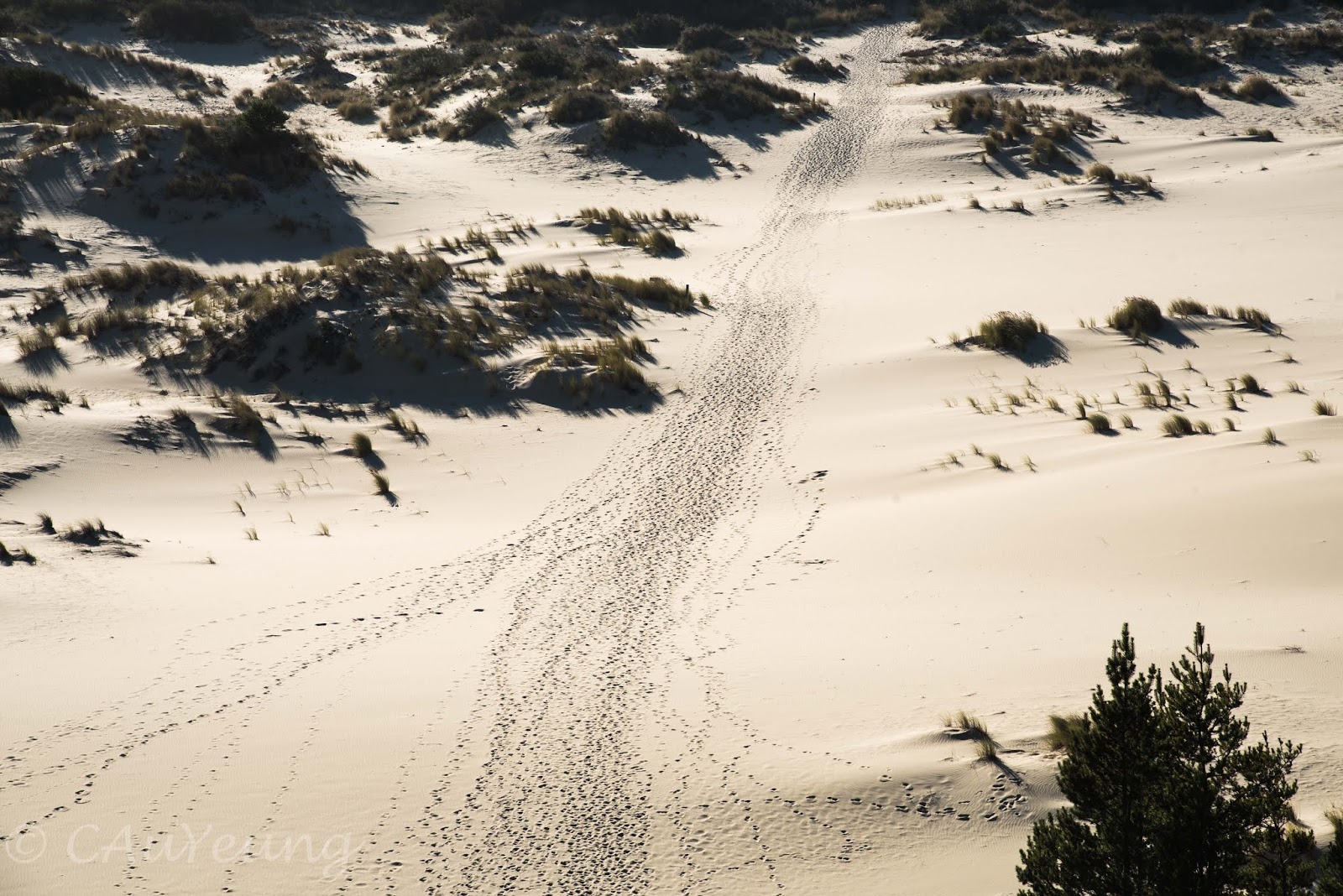
After Cape Perpetua, the Oregon Dunes was the most unique feature in the south. The dunes stretched from Florence down to North Bend. We saw one section of the dunes near Florence on our way down to Bandon Beach where we spent our last two nights on the Oregon coast.
 |
| View from the Oregon Dunes Overlook - the dunes stretched all the way down the coast |
 |
| Looking down at the trail from the overlook | | |
Bandon was
just an hour from the dunes so we were able to visit the southern section
of the Oregon dunes the following day. We would have missed this even
more spectacular section of the dunes if we didn't see a photo of the
Dellenback Dunes in the "Mile-by-Mile" publication.
The Dellenback
trail is 5.5miles over sand all the way to the sea, not an easy hike. We
opted just to do the 1 mile interpretive loop trail which took us to
the huge sand dunes and gave us a taste of the desert without being too
strenuous. We felt our knees nevertheless the following day because it
was tough walking in sand.
 |
| The Dellenback Dunes are further south and seemed bigger. |
 |
| Not quite the Sahara but good enough... |
 |
| Curvaceous! |
Bandon Beach was even more spectacular than Cannon Beach, more remote and much quieter. This whole southern stretch is very scenic and much less commercialized than the north coast. Close to Bandon are a couple of coastal lookouts - FaceRock Park and Coquille Point with Bandon Beach in between. They provide views of Bandon Beach from the north and south.
 |
| View from FaceRock State Park |
 |
| View from Coquille Point |
We also took the scenic drive to Shore Acres State Park, which used to be the grand estate of timber baron Louis Simpson. It included a formal garden, an Oriental garden, hiking trails and its own private beach.
 |
| View from Shore Acres |
 |
| The formal garden inside the estate |
 |
| The Oriental Garden |
 |
| The secluded private beach |
Along
the scenic drive, there are lookouts on a sea lion colony. Somewhere north
along Hwy 101 is a business charging quite a few bucks for you to visit
their sea lion cave but didn't guarantee a sea lion sighting. Skip that
and come here to watch the sea lions cavort in the waves instead.
 |
| Sea lion colony |
 |
| Several pods of pelicans returning home in late afternoon near Shore Acres |
 |
| The Conde McCullough Memorial Bridge on the way south to Bandon |
We made sure we arrived back at our Inn before dark so we could enjoy sunset on the beach. It was a cold and windy evening so the beach was deserted, but the sunset was spectacular. It was our last evening on the coast - surely a place we would like to come back to.
 |
| View from our balcony - miles of beach and not a soul |
 |
| Goodnight, Bandon! |
Next post: Heading inland to Crater Lake