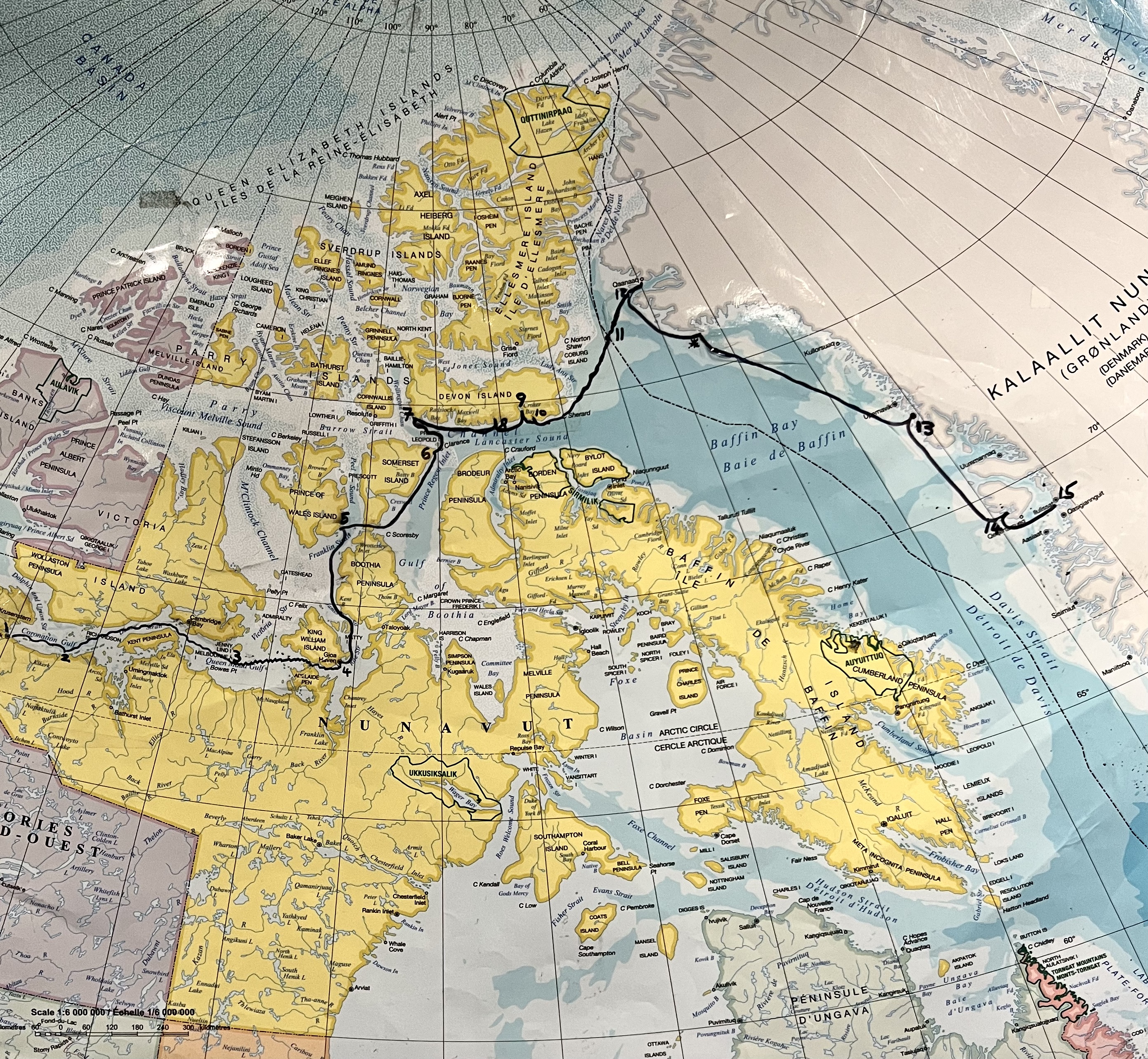
I am sharing with you here a memorable journey to the Canadian Arctic via the Northwest Passage, a historical sea lane through the Canadian Arctic archipelago. We travelled with Adventure Canada and boarded the Ocean Endeavour in Kuqulutuk, Nunuaut, travelling eastward along the passage then north to the high Arctic, crossing the Baffin Sea to Qanak before going down the Greenland coast to our final destination, Kangerlussuaq. Almost all the boardings and landings (usually wet) were via zodiac so I was glad I have had a similar experience visiting Svalbard which helped. Zodiac cruising could be unpredictable, what started out as a calm ride could end up being so stormy on the return trip that even docking alongside the ship could be hazardous.
It was for me a trip of a life time, at times physically strenuous and challenging for both the senses and the intellect in the sense that I was bombarded with new experiences and information, sometimes outside my comfort zone yet at the same time exposing me to exciting new environments and contexts that I have never experienced before. This is not to mention the amazing vistas of the tundra and the Arctic ocean, the Greenland fjords and monstrous icebergs. Breathtaking and mind boggling - but that's what an adventure is all about!It took me a while to digest all this after the 17 day long trip and the upcoming blog posts will be my attempt to make sense of what I have seen and heard on the journey.
 |
| Our route on a polar map |
 |
| This is the original route but we were unable to get to Grise Fjord on Ellesmere Island because of packed ice. |
 |
| The top deck of the Ocean Endeavour, where we spent a lot of time with our cameras |
As we travelled east, our first stop was Port Epworth or Kuluktuluq, which means Tree River. (You will notice that most places in Nunavut have two names, the English name which is often named after some important person in England but doesn't tell you anything about the place, and the Inuit name, which usually tells you something about the place.)
 |
| Port Epworth from the ship |
 |
| Close-up of the sedimentary rock formation at Port Epworth. |
Geology was the main reason we stopped here. This is where we would see stramatolites, layered sedimentary formations created by microorganisms 1.9 billion years ago, the first preserved form of life on this planet. These microorganisms produced adhesive compounds that cement sand and rocky materials together, forming bacterial mats one on top of the other. I
t was a 3.5 km return hike over boggy tundra to get to the viewpoint where there was a platform of stramatolites. Because the hike involved some clambering over rocks without a trail and there was a height gain equiavlent to 14 floors, the operation was declared an advanced hike. No surprise then that everyone suddenly became an "advanced hiker" because they all wanted to see the view of the stromatolites up on the platform!
 |
| Boggy terrain - it is best to walk in wet boots over this kind of wet bog, but if you also have to climb up the hillside, the boots didn't have as good a grip as your hikers. But walking in your hikers meant wet feet even if they are waterproof as you could sink right into the bog and the water come over the top! |
 |
Brilliant fall colours on the Arctic tundra - what a treat!
|

 |
| Lichens abound on the rocks |
 |
Stromatolites |
 |
This was the view we all came for! The expanse of the stromatolites in front of us on the plateau, the bear guard in orange for perspective, the Tree River in the distance. Geologist Dr. Marc St. Onge was there to explain the history of the stromatolites. The stromatolites were some of the earliest traces of life - organisms that generated the oxygen we have today. The place we were standing on used to be the bottom of the sea.
 | | Table of daily finds kept on board |
|
 |
Stromatolites come in all sizes and this one gives you a relative size of the ones we were standing on. You can also see some in cross-section on the hillside. The humans are there to provide perspective.
|
 |
| Tbe Arctic Willow, much smaller than its relative in temperate zones because of temperature and precipitation factors. |
After the climb up to the stromatolites platform, we took our time going back to the ship, enjoying the many Arctic plants on the tundra. The afternoons on board were filled with lectures - on that particular day it was one on the fascinating Geological History of Arctic Canada and Greenland by Dr. Marc St. Onge. This was followed by another interesting lecture on "How do Arctic Animals Survive".
Postscript: Margaret Atwood was inspired by her trip to Port Epworth with Adventure Canada to write a short story Stone Mattress in her collection "Nine Wicked Tales". It's a murder story but it also gives you a sense of shipboard life!
Next stop: Gjoa Haven